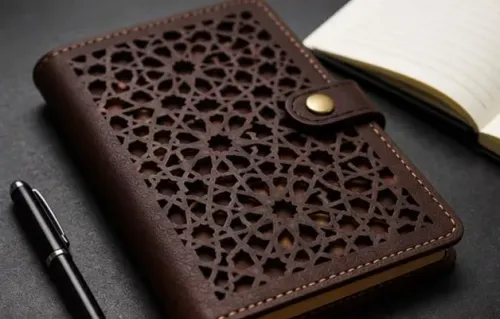
The value of a custom laser-cut leather handbag depends on the leather, pattern geometry, production quantity and finishing work—not simply on the cutting method. You will be able to compare laser cutting with other methods, reject unsafe materials, prepare usable artwork and calculate whether a Noida order suits your budget and sales volume.
Key takeaways
- Use laser cutting for intricate designs, short runs and frequent artwork changes.
- Confirm the leather finish and test the cut edge before production.
- Send vector files with dimensions, hole sizes, bends and assembly notes.
- Approve a complete sample before releasing the production quantity.
When laser cutting earns its cost over other methods
Laser cutting earns its cost for small or medium runs with intricate perforations, repeated panels, engraving or frequent design changes. It removes die-making expense and repeats digital artwork accurately, but a simple, high-volume handbag may cost less with a steel die.
Hand cutting suits one-off prototypes; CNC cutting suits thicker, flatter parts but adds programming time.
| Method | Best fit | Main trade-off |
|---|---|---|
| Laser cutting | Complex patterns and small batches | Heat-darkened edges, smoke cleaning and material waste |
| Die cutting | Large runs with stable shapes | Upfront die cost and poor economy for revisions |
| Hand cutting | One-off samples or irregular hides | Slow output and operator-to-operator variation |
| CNC cutting | Thick leather and broad simple panels | Tool marks, slower intricate perforations and setup cost |
| Traditional tooling | Decorative impressions, not through-cuts | Skilled labour and limited repeatability |
For custom laser cut leather for handbag in Noida, approve a physical minimum-feature and bridge test before ordering. Narrow bridges, sharp internal corners and tiny holes can burn, tear during stitching or distort over a mould.
The laser is a poor choice if the design has broad plain panels, low volume with no repeat order, or a pale finish that cannot hide a dark edge.
Compare quotes for laser cut leather bags in Noida by separating hide cost, nesting yield, artwork, cutting, cleaning, edge finishing, rejects and assembly. Confirm whether the job ends at cut panels or includes skiving, lining, stitching and hardware. Also verify that coated leatherette contains no PVC or another material that releases hazardous fumes when heated.
Which leather is safe to laser, and what happens to the edge
Approve the hide before approving the handbag design: a screen rendering cannot show scorching, shrinkage or a brittle cut edge. Vegetable-tanned, chrome-tanned, suede and split leather can produce different results even at the same laser power.
| Material | Likely laser result | Approval condition |
|---|---|---|
| Vegetable-tanned leather | Crisp cut with a brown to dark edge and smoky odour | Approve a test cut if the dark edge suits the design |
| Chrome-tanned leather | Cuttable, but the edge can darken, curl or become brittle | Confirm the tannery specification and inspect both faces |
| Suede or split leather | Fuzzy, darkened edge; nap can collect soot | Test the visible side and specify cleaning limits |
| PVC-coated leatherette | Heating can release corrosive chlorine-containing fumes and damage equipment | Reject unless composition is documented as PVC-free and the operator confirms suitability |
Do not treat “faux leather” as a material specification. Request the fibre and coating declaration, safety data sheet, or supplier statement before sending material for processing. Laser cutting does not remove tanning chemicals or make a skin-contact panel safer; request restricted-substance documentation for bags that touch the body.
Before ordering laser cut leather bags in Noida, approve these physical details in writing:
- Maximum darkening, smoke staining and edge roughness
- Whether the cut edge remains exposed, painted, folded or covered
- Minimum bridge width and hole diameter after testing
- Panel-to-panel colour tolerance and grain-direction rules
- Acceptable scorching, distortion and reject percentage
A clean-looking edge is not automatically a strong edge. Pull-test narrow bridges and stitch holes on a sample before production.
How to design perforations and panels that survive use
Design the weakest detail before approving the artwork: a narrow bridge can char, shrink or tear even when the motif looks clean on screen. For a leather laser cut handbag design in Noida, require a minimum-feature-size drawing and a physical bridge test on the chosen hide.
1. Set the smallest bridge, hole and slot from a cut sample, not from the CAD file. Test the pattern in the actual leather thickness, because heat damage and tearing increase as features become narrower.
2. Keep perforations away from stitch lines, folded edges, handle bases and hardware holes. Use rounded internal corners; sharp corners concentrate stress and start tears when the panel is pulled over a mould.
3. Add a continuous seam allowance and reinforce high-load zones with a backing patch or a wider solid border. Do not let decorative cut-outs interrupt the material around handles, magnetic snaps or strap anchors.
4. Assemble a sample using the intended thread, needle size, stitch spacing and mould shape. Pull the panel over the mould, flex it repeatedly and inspect every bridge, corner and stitch hole for cracking, stretching or distortion.
Laser cutting does not replace skiving, edge preparation or finishing. Confirm who will skive folds, clean smoke residue, paint or burnish edges, attach lining and set hardware; otherwise a cutting-only job may leave fragile, unfinished panels. Reject artwork that survives visual inspection but fails stitching or flex testing.
What to send a Noida job worker and what the quote must include
Send a job worker a production pack, not a reference photo, and make the quote define whether you are buying cut panels or finished handbags. Leather handbag job work in Noida may cover outsourced cutting only; a custom leather handbag manufacturer in Noida may also skive, line, stitch, paint edges and fit hardware.
Put that process boundary in writing.
1. Provide an SVG, DXF or AI file at 1:1 scale, plus a dimensioned PDF showing seam allowances, fold lines, hole diameters, panel names, quantities and grain direction. Mark artwork that is cut, engraved or scored, and include a minimum feature-size and bridge test.
2. State the leather thickness, finish, colour, hide direction, panel-to-panel colour tolerance and acceptable edge appearance. Include a supplier declaration for synthetic leather; reject PVC-coated material unless the operator confirms it is safe for the machine. Require enclosed-machine extraction, not a smell-based safety check.
3. Specify positional tolerance, engraving depth or contrast, cleaning method, skiving thickness, stitch-hole spacing and the acceptable reject percentage. Ask Laser Job Services, or any alternative supplier, to confirm these points before production rather than interpreting “clean cut” later.
4. Demand an itemised quote separating hide cost, nesting yield, CAD preparation, laser cutting, engraving, cleaning, edge finishing, skiving, assembly, hardware, packaging and rejects. Ask whether the price is per panel, operation or completed bag, and identify setup charges, minimum quantity, taxes, delivery and the cost of replacing failed pieces.
Related products
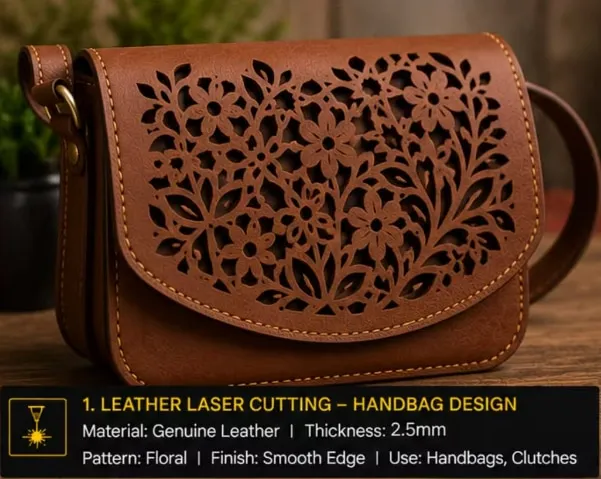
 | Leather Laser Cutting Leather Laser Cutting Handbag Design Leather Laser Cutting – Handbag Design | Premium Laser Job Services Enhance your leather handbags with our professional Leather Laser Cutting... View product → |
 | Leather Laser Cutting Leather Laser Cutting – Bag Panel Design | Premium Laser Job Services Create stylish and premium leather bags with our precision Leather Laser Cutting Services for handbags, tote bags,... View product → |
How to approve a sample before ordering a production run
Approve the sample only after testing the physical bag, not the screen rendering. Write measurable limits into the purchase order before production; “clean cut” and “dark engraving” invite disputes.
1. Compare every leather panel in daylight against an approved swatch. Set a panel-to-panel colour tolerance, grain-direction rule and acceptable shade variation; reject panels outside those limits.
2. Measure hole diameter, bridge width and feature position with calipers or the production template. Pull the panel over the bag mould and inspect narrow bridges and sharp corners for stretching, cracking or heat distortion.
3. Bend the finished bag repeatedly, tug the handles and load it with the intended contents. Stitching must not enlarge perforations, tear bridges or separate from the leather. Record the test cycles and the load that defines acceptance.
4. Inspect cut edges on the outside, inside and flesh side. Approve the dark brown-to-black heat edge, shrinkage, smoke staining, odour and engraving depth or contrast only if they match the design; pale or luxury bags may require painted, folded or covered edges.
5. Confirm lining, skiving, hardware and strap alignment if the quote includes them. Set an acceptable reject percentage and require replacement or credit for failures.
For a leather laser cut handbag design in Noida, request the signed sample and test record before ordering. The same discipline protects any custom laser cut leather for handbag in Noida from inconsistent batches.
Frequently asked questions
When is laser cutting worth the cost for a leather handbag?
Laser cutting earns its cost for small or medium runs with intricate perforations, repeated panels, engraving or frequent design changes. A steel die can cost less for a simple, high-volume design.
Which leather can be laser cut for handbags?
Ask the job worker to identify the leather finish and test a swatch first. The test reveals edge darkening, odour, shrinkage, charring and whether the surface coating reacts poorly to the laser.
What should a Noida laser-cutting quote include?
Request the material specification, leather thickness, artwork preparation, programming, cutting, engraving, sample charges, wastage, finishing, taxes, delivery timeline and minimum quantity.
How do you approve a laser-cut leather handbag sample?
Check panel dimensions, hole spacing, edge colour, smell, surface marks, stitching alignment, handle attachment and hardware fit. Load the bag and test the perforations before approving production.
Keywords