The right cover depends on whether you value repeatable dimensions and detailed cut patterns or visible artisan variation and hand-shaped construction. By comparing material behaviour, fit, durability, personalisation, order size and total cost, you can choose the suitable method for one cover or a larger Noida order.
Key takeaways
- Choose laser cutting for repeatable outlines, slots, perforations and patterns.
- Choose handmade construction for hand-finished edges, tooling and natural variation.
- Specify notebook dimensions, leather thickness, artwork and closure before cutting.
- Compare quotations by material, construction, finishing, quantity and delivery terms.
Laser cutting and handmade construction: what actually differs
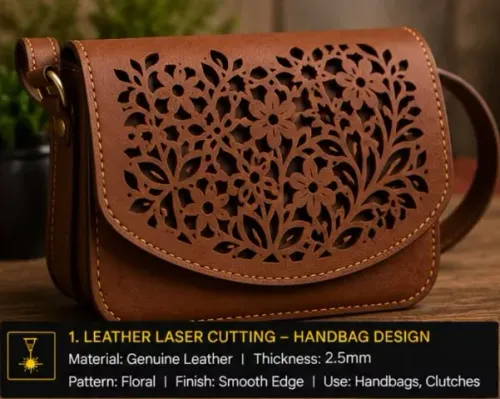
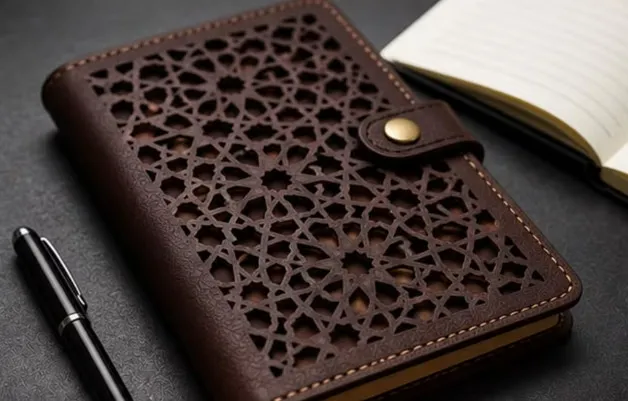
The main difference is repeatability: a laser-cut cover reproduces the same outline, slots, perforations, stitch holes and geometric pattern, while handmade work introduces hand-cut edges, tooling, burnishing, hand stitching, embossing and natural variation.
| Method | Precision and appearance | Originality, durability and speed |
|---|---|---|
| Laser cutting | Consistent dimensions, hole placement and fine patterns; edges may show darkening or smoke | Fast to repeat after artwork approval; strength still depends on leather, hole geometry, thread and edge distance |
| Handmade construction | Visible artisan variation, shaped edges and adjustable stitch alignment | More individual character; extra labour for cutting, skiving, stitching and finishing makes repeat batches slower |
For a leather laser cut notebook cover versus handmade cover in Noida, choose laser production when identical corporate gifts, wedding favours or branded merchandise must meet a deadline. Choose handmade work for a one-off cover requiring artisan adjustment, irregular leather or complex fitting.
Do not assume handmade means every operation is manual: a workshop may use machine stitching, skiving equipment or clicker dies before hand assembly.
Cost depends on quantity and setup. Laser work adds artwork preparation, nesting, focusing and material-test charges; handmade work adds pattern development and labour. Ask whether the supplier accepts one sample, a small batch and future reorders, because minimum order quantity is workshop-specific.
A repeat order can favour laser cutting, while a unique design may make handmade construction more economical.
Leather, heat and construction details determine durability
Durability starts with the material specification, not the pattern. For a custom leather notebook cover in Noida, confirm genuine leather, PU, bonded leather or coated textile; hide thickness in millimetres; grain type; surface coating; colour consistency; tannage; and written permission from the supplier for laser processing.
Vegetable-tanned leather often gives a clear dark engraving, while chrome-tanned, heavily coated and synthetic materials can scorch, discolour, smell or release harmful fumes. Never laser-cut PVC or vinyl imitation leather: chlorine can create corrosive, hazardous by-products.
- Require a cut-and-engrave test on the exact production leather, using extraction and fire controls.
- Accept that a laser edge may be dark, hardened or smoky; handmade edges can be skived, painted, burnished or folded.
- Preserve uncut bridges around folds, corners, elastic slots and pen loops because dense cutouts create tear paths.
- Specify stitch-hole spacing, thread, edge distance and closure attachment.
- Approve an open-close cycle sample. The spine may need skiving, lining, a flexible gusset or a separate spine piece.
| Option | Durability implications | Better fit |
|---|---|---|
| Laser-cut cover | Precise holes and repeatable cutouts, but thermal edges and dense patterns need inspection | Flat-panel production with controlled bridges |
| Handmade cover | Skived hinges, folded edges and hand finishing accommodate movement | Heat-reactive leather, deep tooling or complex construction |
Heat-reactive leather or parts that cannot be assembled flat can make handmade work safer and longer-lasting.
Fit, artwork and personalisation must be specified before cutting
A beautiful cover still fails if its pattern ignores the notebook’s expanded spine or places the logo across a fold. Measure the assembled notebook, not just its pages, before approving a personalized leather notebook cover.
1. Record paper size, finished height and width, spine width, paper thickness, closure allowance, corner radius, pocket dimensions, and elastic or strap position. State whether the design is a sleeve, wraparound, refillable, elastic-bound or hard-shell cover; each requires different cut and assembly details.
2. Provide vector artwork in the maker’s accepted format at 1:1 scale. Separate cut lines from engraving areas, specify line weights that survive handling, keep closed paths closed, mark open paths deliberately, and mirror artwork transferred to the reverse side.
3. Put names, initials, logos, dates or monograms on a flat panel before assembly when possible. Confirm the font, maximum artwork size, placement tolerance, and whether each mark is engraved, cut through, embossed, debossed, foil-stamped or printed.
4. Keep artwork away from folds, stitch lines and dense perforation. Confirm minimum leather bridges around corners, elastic slots and pen loops; dense cutouts can create tear paths. Approve a physical proof cut and engraved in the production leather.
Laser contrast is not an exact ink colour. If a brand requires a precise colour, choose foil or printing instead, and approve the result under normal lighting rather than from a screen image.
Choose by order type, not by the label “laser” or “handmade”
For one personalised notebook, choose handmade construction for a hand-selected hide, visible hand stitching, irregular organic character, one-off tooling, complex folded construction or artisan adjustment during fitting. Choose laser cutting when repeatability and deadline control matter more than individual variation.
| Order type | Better choice | Why |
|---|---|---|
| One personalised notebook | Handmade | The maker can adjust the fit, stitch tension, folds and tooling to the specific hide. |
| Corporate gifting batch | Laser cutting | Names, logo positions, outlines and stitch-hole patterns stay consistent across units. |
| Wedding favours or branded merchandise | Laser cutting | A reusable pattern supports faster production and uniform presentation. |
| Repeat production order | Laser cutting or hybrid | A master vector pattern, approved material test and physical sample make reorders predictable. |
Laser work is the wrong choice when the finish reacts badly to heat, the mark requires deep hand tooling, or shaped parts cannot be assembled from flat pieces. A heat-sensitive coating can scorch or discolour instead of producing a clean edge.
A hybrid often delivers the strongest commercial result: laser-cut panels and stitch holes combined with handmade skiving, stitching, edge finishing and final assembly. Compare the time needed to find and brief an artisan for one cover with the setup time for a reusable pattern across several covers or future orders.
How to order and compare a Noida supplier’s quotation
Give the supplier one written specification, not a reference photograph. State the finished cover dimensions, notebook paper size and thickness, spine allowance, leather type, thickness in millimetres, grain, lining or reinforcement, closure method, pocket sizes, edge finish, stitch specification, colour tolerance and personalisation position.
- Request a cut-and-engrave material test using the exact production leather.
- Approve a physical proof from that leather before confirming batch quantity, delivery date, packaging and replacement criteria.
- Define acceptable burn marks, engraving contrast, dimensional variation and logo-placement tolerance.
Separate one-time charges from the repeatable unit price:
| Charge | Confirm separately |
|---|---|
| Artwork setup, pattern development, nesting and focusing | One-time or charged per revision |
| Sampling and physical proof | Sample charge and number of included corrections |
| Cutting, stitching, hardware and finishing | Per-piece charge |
| Leather, lining, wastage, packaging, GST and delivery | Included or additional |
A leather notebook cover manufacturer in Noida should also state the minimum order quantity, artwork correction limits and reordering terms. Laser Job Services is useful for local discussion of dimensions, leather trials, vector files, batch quantities and delivery requirements, but compare its proposal against the same specification.
Judge quotations by the approved proof, not by “premium,” “laser” or “handmade.” A low unit price that excludes leather grade, hardware or replacement responsibility is not a lower cost; it is an incomplete quote.
Related product
 | Leather Laser Cutting Leather Laser Cutting Notebook Cover Precision Laser Job Services Premium Leather Laser Cutting for Custom Notebook Covers Enhance the elegance of your stationery with our Leather Laser... View product → |
Protect the finished cover and review the trade-offs after delivery
Open and close each cover repeatedly before accepting delivery. This exposes spine stress and tests whether the notebook stays secure without forcing the fold.
- Inspect the spine for stress, loose stitches, enlarging stitch holes, peeling edge paint, detached elastic and closure movement.
- Check every cutout for sharp, unsealed edges. Confirm engraving contrast, dimensions, hole placement and logo position against the approved proof.
- Reject the batch if any measurement, colour, burn mark or odour falls outside the agreed tolerance.
- Keep both finishes away from moisture, high heat and direct sunlight. Avoid rough surfaces and test dark dye against pale clothing or paper to detect transfer.
- Wipe dust with a soft, dry cloth. Follow the leather maker’s instructions; do not apply an untested conditioner to a coated finish.
Handmade covers can provide richer tactile variation, while laser-cut covers offer cleaner repeatability. Choose the finish whose material, construction and production process match your daily use.
Frequently asked questions
What actually differs between laser-cut and handmade leather notebook covers?
Laser cutting delivers repeatable outlines, slots, perforations, stitch holes and geometric patterns. Handmade covers use hand-cut edges, tooling, burnishing, hand stitching and natural variation.
What determines a leather notebook cover’s durability?
Leather type and thickness, heat exposure, edge finishing, stitch-hole placement, thread, lining and closure design all affect durability.
What details must you specify before ordering a personalised leather notebook cover?
Provide the notebook’s exact length, width and thickness, corner radius, spine clearance, closure position, artwork file, engraving size and required quantity.
How should you compare a Noida supplier’s quotation?
Compare leather grade and thickness, cutting method, construction, personalisation, finishing, sampling, quantity, delivery time, taxes, packaging and revision terms.
Keywords