Seasonal displays must change quickly without turning every campaign into a heavy transport, storage and installation project. By the end, you will know when EVA foam is the practical choice, how to specify and cut it for repeated use, and when another material or a stronger support system is safer.
Key takeaways
- Choose EVA foam when lightweight, fast-changing displays matter most.
- Specify foam thickness, surface finish, colour, dimensions and mounting method before ordering.
- Check cut edges, artwork scale and sample approval before production.
- Use removable fixings and flat storage to protect panels for reuse.
Why EVA foam works for fast-changing seasonal displays
At comparable panel sizes, EVA foam weighs substantially less than MDF, plywood, or acrylic. That makes seasonal changeovers faster, reduces vehicle space and lifting effort, and allows staff to store more campaign elements between uses.
A large unsupported sheet can still flutter, curl, or lift in wind, so outdoor displays need a rigid backer, perimeter frame, or mechanical fixing.
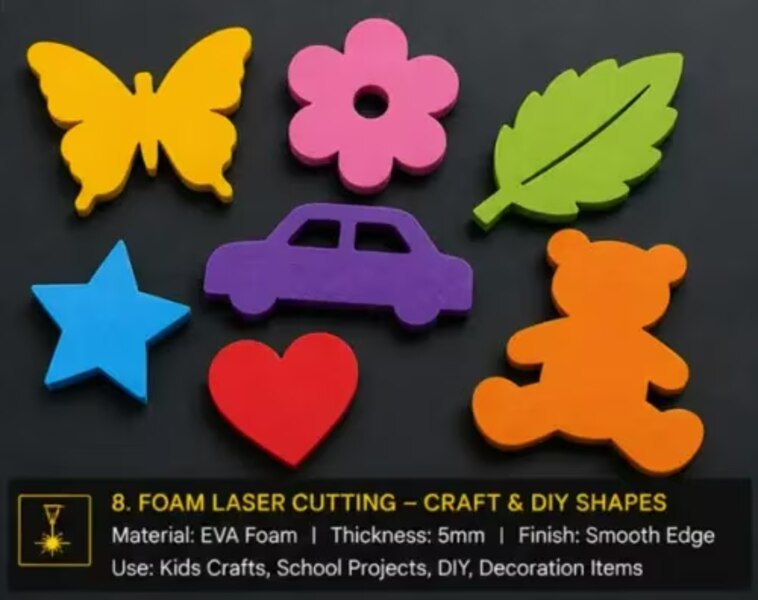
Its soft, flexible structure also suits temporary décor that changes without committing to a permanent installation. Businesses can cut replacement shapes, lettering, borders, and layered motifs for:
- Diwali entrances, window surrounds, and illuminated backdrops
- Christmas and New Year retail displays
- Wedding stages, photo walls, and hanging ornaments
- School functions, exhibitions, and corporate events
- Short retail promotions with different colours or campaign messages
seasonal foam display panels in Noida are practical when the display must be handled, transported, installed, removed, and packed again without the weight of a rigid board. A sample also helps you test whether adhesive, paint, printed faces, or inlays survive the planned number of changes.
Do not treat EVA as automatically weatherproof or venue-approved. Sunlight, heat, dust, and wet-dry cycles can fade or distort it, while ordinary EVA remains combustible. Request the sheet’s documented fire classification and confirm venue rules before using hanging décor, wall coverings, or panels near exits.
Where EVA foam beats other display materials—and where it does not
Choose EVA when low weight and quick changeovers matter more than rigid, furniture-like construction. Compare the panel size, fixing method, expected weather, handling frequency and required finish—not just the material price.
| Option | Weight and rigidity | Finish, moisture and reuse | Best fit and drawback |
|---|---|---|---|
| EVA foam | Very light; flexible and prone to flutter on large panels | Matte, tactile surface; closed-cell grades resist splashes, but heat, sunlight and wet-dry cycles can distort or fade it | Good for ornaments, lettering and soft-edged décor; needs a frame or backer outdoors |
| MDF | Heavier and rigid | Smooth, paintable face; swells after water exposure and chips at edges | Strong indoor backdrops and crisp painted graphics; harder to transport and reuse |
| Acrylic | Heavier than EVA, rigid and clean-looking | Gloss or transparent finish; handles splashes but scratches and cracks under impact | Premium illuminated or high-contrast signs; costs more and needs careful packing |
| Plywood | Rigid and impact-tolerant | Paintable grain; better than MDF against brief moisture, not prolonged rain | Structural-looking displays; heavier and less finely decorative |
| Fabric | Light and foldable; requires tensioning | Printed colour and soft finish; can crease, soil and absorb water | Large backdrops; lacks EVA’s raised depth |
| Thermocol | Very light but brittle | Easy to dent, sheds beads and usually suits one campaign | Cheap volume décor; poor for repeated handling |
| Printed flex | Light, rollable and flexible | Strong printed graphics; can crease, glare and flap | Wide banners; lacks dimensional lettering and tactile impact |
Reject EVA for open flames, heavy loads, high-abrasion zones or an outdoor panel that must stand unsupported. A venue’s fire rules also matter: request the foam’s documented classification before ordering.
How to specify a panel that stays attractive and intact
A reproducible specification needs more than “EVA foam panel.” State the thickness, density, surface treatment, finished size, unsupported span and fixing method, because two EVA sheets with the same label can bend, cut and age differently.
1. Match thickness to the job: specify 3–5 mm for wall graphics and small ornaments, 5–10 mm for backdrops, and 10–20 mm for partitions. Add a rigid carrier, perimeter frame, relief cuts or segmented construction when a large panel must remain flat.
2. Request the density or grade in kg/m³, plus an allowed tolerance. A practical starting point is 80–120 kg/m³ for decorative panels and 120–180 kg/m³ for freestanding or frequently handled partitions. Confirm the maximum unsupported span rather than assuming thickness alone prevents sagging.
3. Name the finish: solid colour, textured face, printed surface, painted coating or laminated facing. Specify colour reference, gloss level, visible-edge treatment and cleaning method. A laser-cut edge can show molten beads or attract dust, so require a concealed edge, border or retained trim for high-touch displays.
4. Give finished dimensions, panel count, joint locations and every cut-out’s shape, size, corner radius and edge clearance. For hanging ornaments, add hole diameter, hole-to-edge distance and the rated attachment point; for partitions, specify feet, hinges and maximum module width.
Include storage temperature, replacement tolerance and permitted adhesive or fixing. For custom foam panels for events in noida, approve a sample for kerf, corner rounding, odour, backside residue and dimensional accuracy before production. Ask for documented fire classification and venue acceptance; “fire-retardant” alone is not approval.
What to verify before ordering laser-cut EVA panels
A repeat order begins with a signed-off sample, not a supplier promise. For eva foam decorative panel cutting in noida, qualify the material, machine result, artwork and assembly as four separate checks.
1. Request the EVA sheet’s thickness, density or grade, colour, facing, storage temperature and replacement tolerance. Check a physical sample for flatness, cell consistency, odour, surface damage and colour matching. Record the maximum unsupported span, because two sheets sold as EVA foam can bend and age differently.
2. Ask for a material-specific test grid that varies power, speed, focus and number of passes. Measure through-cutting, kerf width, corner rounding and dimensional accuracy, then inspect edge melt, backside residue and lingering odour. Keep the approved settings with the drawing; changing sheet thickness or grade invalidates the result.
3. Test the actual graphics at viewing distance. Laser engraving on EVA often creates a shallow, darkened or melted mark rather than crisp tonal contrast. Use through-cut lettering, contrasting inlays or a separately printed and laminated face when small text or logos must remain readable.
4. Build and handle one complete panel before approving production. Check relief cuts, segmented joints, curling, flutter, carrier attachment and the permitted fixing method. Large outdoor or freestanding pieces need a rigid backer, perimeter frame or mechanical fixing.
5. Obtain the material’s fire-performance classification and confirm the venue’s rules for wall coverings, hanging décor, exits and suspended elements. Laser Job Services can use this approved sample and specification to repeat the design without silently changing the sheet or cut settings.
Related products
 | EVA Foam Laser Cutting Foam Laser Cutting – Decorative Panel Our Foam Laser Cutting Services offer premium-quality decorative foam panels designed for interior decoration, wall décor, event backdrops,... View product → |
 | EVA Foam Laser Cutting Decorative Jali Panel Laser Cutting Services Our Decorative Jali Panel Laser Cutting Services offer precision-crafted EVA foam decorative panels designed to enhance interiors, exhibitions,... View product → |
How to install, transport and reuse seasonal panels safely
Prevent damage by keeping panels flat, cool and supported, then choosing a reversible fixing method for each site. EVA foam decorative panels for seasonal displays in Noida are light, but large sheets still curl, flutter or lift in moving air.
1. Store each panel flat between clean, rigid boards with release paper at the face. Keep the stack shaded and dry; heat, trapped moisture and heavy objects can distort foam or mark its surface.
2. Transport segmented panels in a rigid carton or carrier. Protect corners, keep cut-out areas from bearing weight and label each piece so hurried unloading does not cause bends or tears.
3. Test the fixing method on a hidden wall patch for 24 hours. Use a venue-approved low-tack system only when its weight rating covers the panel; never rely on adhesive alone for large panels, ceilings or outdoor work.
4. Prefer a freestanding frame, rigid backer or approved hanging point in rented venues. Keep panels away from exits, fire equipment, walkways and door swings, and remove sharp edges or loose trim that visitors could catch.
5. For outdoor displays, add a perimeter frame or mechanical fixing with ballast, and check the installation after wind or rain. Confirm the foam’s documented fire classification with the venue before installing near lights or electrical equipment.
Before reuse, inspect for curled edges, weakened adhesive, residue, tears and fading. Clean gently without abrasive rubbing, replace damaged fixings and repack panels flat.
Frequently asked questions
Why does EVA foam suit fast-changing seasonal displays?
EVA foam weighs less than MDF, plywood and acrylic at comparable panel sizes, reducing lifting, vehicle space and storage effort during campaign changes.
When is EVA foam a poor choice for a display panel?
Choose another material when the panel needs high rigidity, a hard impact-resistant surface, strong heat resistance or long-term outdoor exposure.
What should you specify before ordering custom EVA foam panels?
Provide panel dimensions, foam thickness, colour, surface finish, artwork, cut-out details, edge requirements and the intended mounting method.
How can you transport, install and reuse EVA display panels safely?
Use removable fixings, avoid sharp bends and compression, protect panels from heat and moisture, and store them flat between campaigns.
Related product
 | EVA Foam Laser Cutting Decorative Partition EVA Foam Laser Cutting EVA Foam Laser Cutting – Decorative Partition | Precision Laser Job Services Transform interiors with our professional EVA Foam Laser Cutting... View product → |
Keywords