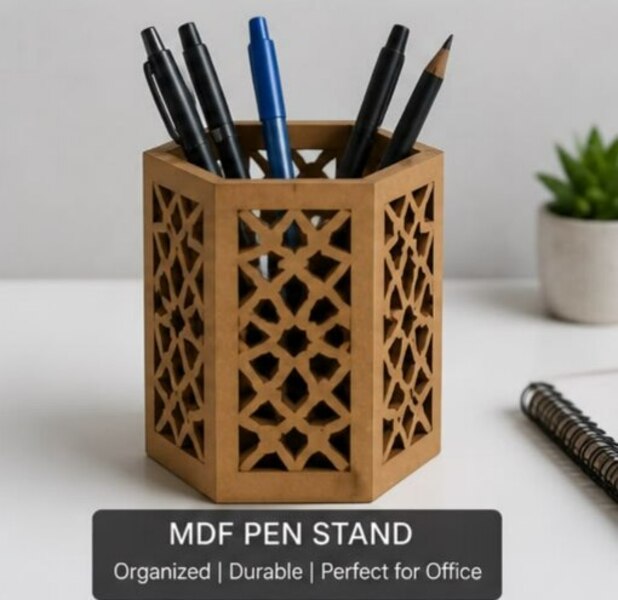
An MDF pen stand can improve control of shared stationery at a reception desk, meeting room or factory administration workstation, but it is not suitable for every industrial setting. By checking the environment, load, construction, finish and replacement needs, you can decide whether MDF offers practical value or whether acrylic, metal, plastic or another material is the safer purchase.
Key takeaways
- Use MDF pen stands in dry, visible office areas—not oily production zones.
- Specify capacity, a wide base and sealed edges for reliable daily use.
- Compare MDF with acrylic, metal, plastic, bamboo and stainless steel.
- Judge branded samples by finish, stability, cleaning and batch consistency.
Where an MDF pen stand earns its place in a factory office
A pen stand earns its place where people repeatedly pick up and return writing instruments, not where tools need protection. The most useful mdf pen stand applications for industrial offices in noida are dry, visible points that support reception, visitors, managers and shared paperwork.
| Location | Main users | Practical value |
|---|---|---|
| Reception counter | Reception staff and visitors | Keeps visitor pens visible and ready for registration forms |
| Visitor-registration desk | Guests and security staff | Supports an orderly handover of pens without searching drawers |
| Plant-manager office | Manager and visiting supervisors | Holds a small personal set for notes and approvals |
| Procurement desk | Buyers and suppliers | Keeps pens, markers and highlighters available for quotations and forms |
| QA or administration workstation | Inspectors and office staff | Separates shared stationery from documents and keyboards |
| Meeting room | Employees, suppliers and customers | Makes writing instruments easy to find and return after meetings |
| Training room | Trainers and trainees | Keeps shared pens and markers together between sessions |
| Onboarding kit | New employees | Provides a branded, useful desk accessory rather than a one-time novelty |
A mdf pen stand for factory offices works best for a small personal set or light shared stationery. Repeated visibility at every reception or meeting-room desk can justify the purchase because the stand keeps serving visitors and employees; a one-off promotional gift has less operational value.
Treat it as an organization and presentation accessory, not storage for box cutters, calibration tools, soldering tools or heavy metal instruments. Those items need a reinforced design or another material. The stand supports orderly handovers, but it does not replace a stationery cabinet.
How dust, oil mist and humidity change the decision
A dry, moderate-duty office is the safest setting for an MDF pen stand for factory offices. MDF is a dry-process fibreboard, so its exposed laser-cut edges absorb moisture faster than its finished faces.
Noida’s monsoon humidity, repeated handling and oil mist can swell edges, soften joints and leave stains; production floors, wash-down areas, outdoor factory locations, oily environments and wet pantries are poor fits.
- Inspect the location before approving MDF. Choose it for a reception, enclosed administration desk or meeting room, not beside a machine, open loading bay or wash station.
- Require sealed edges and a moisture-resistant finish near a pantry or on any desk that is wiped frequently. Raw MDF tolerates dusting only; paint, laminate, veneer and clear coating each have different resistance to water, disinfectant and solvent cleaners.
- Obtain written cleaning instructions before purchase. Do not assume a painted or laminated surface accepts a wet cloth, alcohol disinfectant or solvent; the wrong cleaner can lift coating, mark veneer or expose the fibreboard.
- Request an edge-residue check. Laser-cut MDF often leaves dark soot that transfers to fingers and pale desks unless brushed, sealed, painted or concealed.
- Ask how the supplier extracts dust and smoke during cutting. Poor extraction leaves residue and signals a process-control problem, even when the logo engraving looks sharp.
Choose another material when frequent disinfectant cleaning, oil exposure, impact, water resistance, outdoor life or ESD control is essential. Non-metallic MDF is not automatically ESD-safe.
What to specify for capacity, stability and daily handling
Specify compartments by contents, not by a vague “pen capacity.” Ballpoint pens and pencils need narrower openings; markers, highlighters and styluses need wider, deeper compartments. A custom MDF desk accessory for companies should state both the number of compartments and the maximum practical load for daily use.
- Request the outside dimensions, base footprint, overall height, MDF thickness and net weight. Test a broad, low centre-of-gravity base with one hand: it should resist tipping when a full compartment is emptied, yet leave keyboards, forms and visitor registers unobstructed.
- Inspect every edge and joint for sharp corners, looseness and movement. Interlocking slots, dowels, screws installed through suitable pilot holes, or an engineered glued joint will outlast adhesive-only butt joints under repeated loading, edge impacts and humidity.
- Compare the sample with its intended duty. An everyday desk unit needs stronger construction and a stable footprint; a lightweight event giveaway can accept thinner MDF and lower capacity because it is not subjected to constant handling.
- Ask for formaldehyde-emission documentation for quantity orders placed in enclosed offices; MDF panels do not all deliver the same indoor-air performance.
- Do not label the stand ESD-safe because it is non-metallic. MDF, paint, laminate and adhesive finishes provide no defined electrostatic-dissipative performance, so electronics workstations need a tested ESD product compatible with the site’s grounding and handling programme.
MDF versus acrylic, metal, plastic, bamboo and stainless steel
MDF is the sensible choice for a custom mdf desk accessory for companies when low weight, shaped compartments and printed or engraved branding matter more than extreme durability. It is easier to customise than metal or molded plastic, but spills, disinfectants, oil and impacts expose its weakness.
Raw or poorly sealed edges swell, shed fibres and create avoidable service calls.
| Material | Practical advantage | Limitation and best use |
|---|---|---|
| Acrylic | Clean, modern appearance; resists moisture and wipes easily | Scratches more visibly and can crack on impact; choose it for presentable, dry-to-damp desks |
| Powder-coated metal | Strong impact resistance and lower replacement frequency | Heavier; coating chips can expose corrosion, so it suits busy shared desks |
| Stainless steel | Strong, corrosion-resistant and washable | Costs more to replace and weighs more; use it near water, chemicals or frequent disinfection |
| Molded plastic | Washable, repeatable in shape and tougher for routine industrial handling | Offers less premium branding and custom form flexibility; suits high-use shared stationery |
| Bamboo or solid wood | Natural grain and warmer appearance | Responds to moisture and needs periodic finish maintenance; select it for design-led dry offices |
| MDF | Lightweight, economical and easy to laser-customise | Performs poorly against water, oil and impact unless sealed; suits moderate-duty branded placement |
Finish changes the decision. Sealed or painted MDF looks uniform and wipes better; laminate improves cleanability but changes texture, while veneer preserves grain and still needs careful moisture control. Ask for sealed edges, not merely a coated face.
Choose MDF for dry, moderate-duty, branded office placement. Compare other materials first when water resistance, high-impact use, ESD control, fire performance or outdoor life is a requirement.
How to buy a branded MDF pen stand without judging only the sample
Approve production only after the supplier proves that the artwork, construction and finish will repeat across the batch. Supply vector artwork, agree a measurable minimum stroke width, letter spacing and engraving depth, and demand a physical logo proof.
Fine strokes, small reversed text and tight lettering can fill with soot or disappear under paint and clear coat.
1. Confirm the specification: MDF panel thickness, outside dimensions, pen capacity, slot fit and logo position. Test the actual pens, not a supplier’s sample.
2. Compare branding methods. Recessed laser engraving gives a durable, serial-style mark with restrained colour; direct printing or applied graphics reproduce multicolour logos more strongly but add coating, adhesion and wear variables. Approve the proof on the specified MDF and finish.
3. Inspect finish controls: engraving contrast, coating coverage, sealed edges, assembly method and cleaning instructions for that finish. Ask how the supplier controls dust, smoke extraction and edge residue during laser processing.
4. Confirm packing protection, replacement units and batch-to-batch colour consistency. Request the MDF panel’s indoor-air compliance documentation, including formaldehyde-emission test or class records, when ordering for enclosed offices.
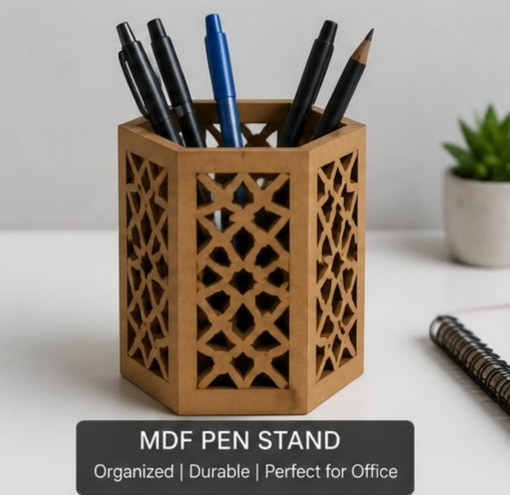
Laser Job Services can be compared with other branded mdf pen stand manufacturer in noida options on these repeatability records, not one attractive prototype. A supplier that cannot document slot dimensions, logo placement and colour control has not yet demonstrated production readiness.
Related product
 | Decorative MDF Coasters Laser Job Services is a manufacturer of precision laser-cut MDF products, offering practical and decorative solutions for offices, workspaces, homes... View product → |
Frequently asked questions
Where are MDF pen stands useful in a factory office?
Use them at reception desks, visitor counters, manager workstations and shared paperwork points where pens are repeatedly picked up and returned.
How do dust, oil mist and humidity affect an MDF pen stand?
Dust can collect in open compartments, oil mist can stain unsealed surfaces, and humidity can swell MDF edges. Keep MDF in dry, clean office areas and specify sealed or coated surfaces.
What should you specify when buying an MDF pen stand?
Specify the number of compartments, dimensions, base width, overall height, edge treatment, surface finish, branding method and cleaning requirements.
How does MDF compare with other pen stand materials?
MDF offers easy shaping, printing and branding, while acrylic gives visibility, metal improves impact resistance, plastic simplifies cleaning, bamboo adds a natural look and stainless steel suits demanding environments.
Keywords