A memory card needs more than a brand name when you must identify its model, capacity, production lot, inspection history or warranty status. By the end, you will be able to choose the right identifier, place it without damaging the card, and specify a marking process that produces verifiable records rather than a merely attractive surface mark.
Key takeaways
- Use marks to connect each card with its batch, inspection record and return history.
- Keep serial numbers short, high-contrast and machine-readable at the intended viewing distance.
- Choose the card surface and laser process after testing readability, heat and substrate damage.
- Specify artwork, code data, position, dimensions and inspection criteria in the production brief.
What product-identification problems does a memory-card mark solve?
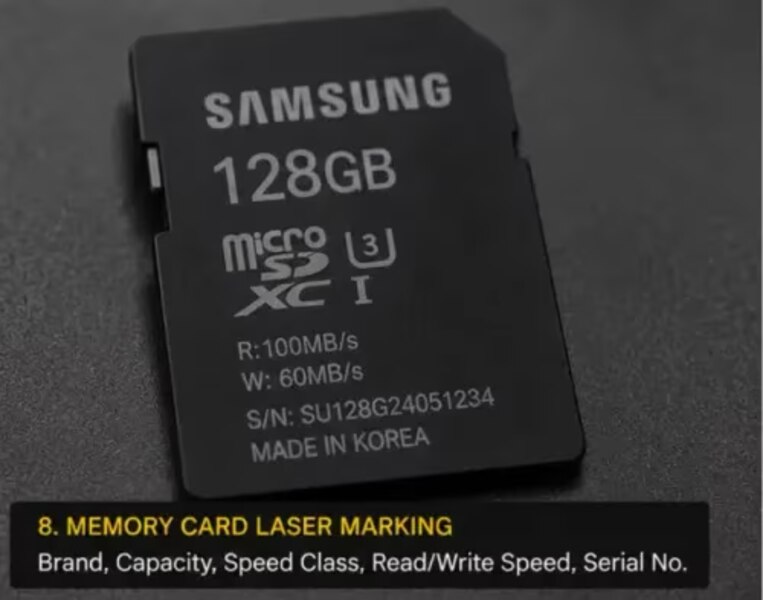
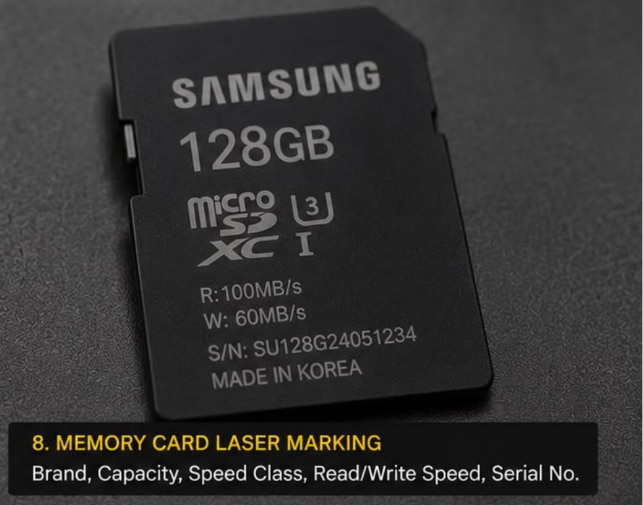
A memory-card mark solves identification gaps that appear during manufacture, inspection, shipment and return. It can show the brand, card family, capacity, production batch and individual unit without relying on packaging or a separate spreadsheet.
For manufacturers in Noida, memory card laser marking uses include visual brand recognition, fast product sorting, lot traceability, warranty checks and counterfeit screening. Use the logo for recognition, a model or capacity code for sorting, and a unique serial number when you must connect one card to its lot, test result, shipment or warranty record.
1. Treat the external serial as a production identifier, not the card’s electronic identity. An SD card also contains an internal Card Identification (CID) register; store the CID and external serial together when both are relevant.
2. Pair a human-readable serial with a machine-readable code when operators scan cards during inspection or inventory movement. A printed number alone leaves room for transcription errors, while a repeated serial, wrong capacity code, missing logo or database mismatch creates a reason to investigate counterfeiting.
3. Decide what the identifier belongs to before approving artwork: the card, its label, the retail package or an accessory. These points are not interchangeable; a package mark cannot prove which individual card was returned or link it to that card’s manufacturing and test history.
A clear identification scheme turns a marked card into a traceable unit rather than merely a branded object.
How should you design serial numbers, logos and 2D codes?
Give each mark one job: use the approved brand logo on the card or package for recognition, model, capacity or speed-class text for sorting, and the serial for unit-level identity. Add model information only when the marking area and approved product artwork support it.
For memory card serial number marking, choose a fixed-length format when scanners, databases and operators need predictable fields. Add a model or batch prefix when it improves sorting, document the allocation rule, and prevent duplicates with a central number-allocation log.
Store leading zeroes as text, record the artwork revision, and link each number to the card’s CID, lot, inspection result and shipment.
A QR Code should usually hold a short opaque identifier that resolves to a controlled database record. Do not encode a customer name, warranty terms, device history or personal data; copied symbols expose those details and make changes difficult.
A memory card QR code marking manufacturer should compare QR Code with Data Matrix using the available square, scanner distance and quiet-zone requirement.
| Type | Primary job | Best use |
|---|---|---|
| Logo | Visual recognition | Brand identification on card or package |
| Serial | Unit identity | Traceability, returns and warranty records |
| QR Code | Database lookup | Consumer or smartphone scanning |
| Data Matrix | Compact machine code | Very small marking areas |
Do not combine logo, long serial, model text and QR Code by default. Every added element consumes area, quiet zone and inspection time; combine them only when each supports a separate identification task.
How do you make a small mark readable without harming the card?
A dimensioned drawing prevents a readable mark from becoming a damaged card. Show the datum, orientation, minimum text height, code size, quiet zone and no-mark zones around contacts, the write-protection switch, seams, housing edges, label graphics and printed technical information.
Confirm the exposed surface before choosing settings. An uncoated polymer shell, painted or coated plastic, and paper or plastic label respond differently. Resin grade, additives and finish determine whether the laser produces ablation, foaming, carbonisation or pigment change; a label setting can discolour or warp a card shell.
| Laser option | Check before selection | Main risk to test |
|---|---|---|
| UV | Fine contrast and small heat-affected area | Surface damage or weak contrast |
| Green | Plastic response and readable detail | Inconsistent pigment change |
| Infrared fibre | Contrast on compatible plastics or coatings | Heating, melting or debris |
| CO2 | Absorption and mark speed | Warping, charring or oversized heat zone |
For electronic component laser marking in Noida, qualify each option against contrast, debris, heat-affected area and card function, not the word “plastic” alone. For a QR code, preserve the quiet zone, choose a module size the scanner resolves at the working distance, and avoid unnecessary density when selecting error correction.
Verify every production mark with a suitable scanner and 2D-code verifier. ISO/IEC 15415 assesses contrast, modulation, fixed-pattern damage, decode performance and unused error-correction capacity; one successful phone scan proves little. After marking, inspect dimensions and connector cleanliness, then run representative read/write or electrical tests.
Which surface and marking method should carry the identification?
Choose the traceability point before choosing the marking technology. A mark on the memory-card housing stays with the card after retail packaging is discarded; a package mark identifies the sale unit or carton, not necessarily the individual card. A stainless-steel accessory receives a separate asset record.
| Surface or method | Strength | Limitation |
|---|---|---|
| Housing laser mark | Permanent unit identity; no ink, ribbon or label consumables; rapid data changeovers | Excessive energy, repeated passes or poor fixturing can melt edges, create debris or heat components |
| Label with thermal transfer or adhesive | Variable data, short changeovers and late-stage updates | Ribbon and label remain separate materials; adhesion, abrasion, peeling, substitution, replacement control and recycling weaken permanence |
| Ink or pad printing | Strong colour choices and fast coverage | Consumables can wear, and ink may require drying |
| Retail-package printing | Clear sale-unit or carton identification | It does not prove which individual card is inside |
| Stainless-steel accessory mark | Durable accessory traceability | It creates a separate asset record |
Select by required permanence, contrast, throughput, recyclability and damage tolerance. For a memory card logo marking service in Noida, qualify laser settings on the actual shell or label, then check code readability, dimensions, contact cleanliness and representative read/write tests.
If the housing cannot produce a stable mark, move the identifier to an approved label or package and record that change. Do not force a cosmetic result onto the card.
What should you include in a production marking brief?
A useful brief removes decisions from the production floor. Give the supplier:
1. Card family, resin or coating, quantity and incoming format: loose cards, trays or panels. Include the artwork revision, approved logo, identifier format, serial-allocation rule, QR or Data Matrix data source, mark location, orientation, quiet-zone dimensions, acceptable contrast and inspection method.
2. A dimensioned drawing showing the datum and no-mark zones. A repeatable fixture controls position; it also affects mark consistency and changeover time. Require a first-article sample before production, then define whether rejected, duplicated or unreadable numbers are quarantined, voided and replaced, or permanently recorded as failures.
3. A production log containing serial number, CID when collected, batch, machine or job reference, inspection result and shipment destination. Your database remains the authority that proves what each mark means; the supplier executes the marking.
4. For electronic component laser marking in Noida, assess the enclosure, interlocks, fume extraction and particulate control against the laser, polymer and coating. These controls protect operators and prevent residue from contaminating cards.
5. If using an SD, microSD, SDHC or SDXC logo, provide approved artwork and confirm usage rights. Do not permit reconstruction or modification of protected artwork.
For a memory card logo marking service in Noida, Laser Job Services can process a defined card population when your production-control plan supplies the rules, approved surfaces and acceptance tests.
Related product
 | Electronic Laser Marking Service Logo, QR & Serial Number Marking Laser Job Services is a manufacturer and service provider specialising in precision laser cutting, engraving and marking for electronic and consumer... View product → |
Frequently asked questions
What product-identification problems does memory-card laser marking solve?
It links a memory card to its brand, product family, capacity, production batch and individual unit without relying on packaging or separate spreadsheets.
How should you design memory-card serial numbers, logos and 2D codes?
Use a short serial format, a simple logo and a 2D code sized for reliable scanning, with quiet space around the code and enough contrast against the card surface.
How do you make a small mark readable without harming the card?
Test mark size, contrast, scanning distance and laser settings on production-equivalent cards, then inspect the mark for distortion, heat damage and contamination.
Which surface and marking method should carry the identification?
Select the surface with the best contrast and durability after testing the card's plastic, coating, label or metal contact area; avoid surfaces that flex, shed or interfere with contacts.
What should you include in a production marking brief?
Specify the artwork, serial-number format, 2D-code content, mark position, dimensions, orientation, permitted contrast, inspection method and sample-approval process.
Keywords