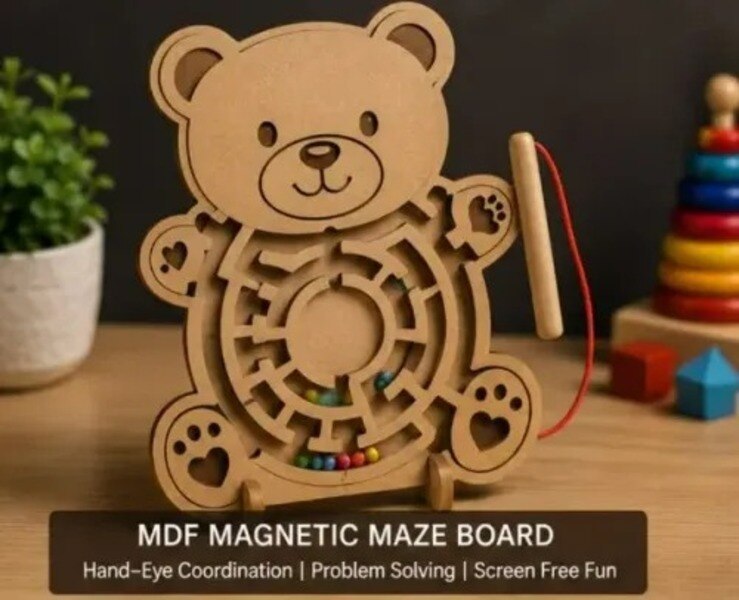
A magnetic maze turns a child’s hand movement into a visible exercise in tracking, control and decision-making: an external stylus guides a captured ball or token through a sealed path. By matching the maze to the child’s age and using purposeful prompts, parents and teachers can turn short play sessions into observable practice rather than a race to the finish.
Key takeaways
- Match route length, turns, and token size to the child’s motor skills.
- Use colour, counting, storytelling, and directional prompts to extend maze play.
- Check the sealed board, smooth edges, captive magnet, and non-toxic finish.
- Specify the learning goal before choosing a custom maze layout.
What does a magnetic maze help a child practise?
A magnet outside or above a sealed MDF board moves a steel ball, bead, or magnetic token through a printed, engraved, or cut route. The loose piece stays captive, so the child practises guiding, tracking, and correcting without handling a separate puzzle part.
| Observable action | Skill practised |
|---|---|
| Moves slowly and keeps the token on the route | Fine-motor control and hand-eye coordination |
| Follows the moving token with the eyes | Visual tracking |
| Holds the board steady while guiding the stylus | Bilateral coordination |
| Looks ahead, chooses a route, or reduces speed at a junction | Planning, spatial reasoning, and attention |
| Recovers from a dead end and tries again | Persistence and early problem-solving |
Watch for the child looking ahead before moving, slowing near a junction, correcting position after an error, using both hands deliberately, or repeating an attempt without abandoning the task. These behaviours provide stronger evidence of controlled learning than reaching the finish quickly.
A magnetic activity board for children is practice material, not a standalone treatment for handwriting or developmental difficulties. Maze performance also reflects attention, visual perception, motivation, and familiarity with the task, so treat the activity as one useful observation rather than a diagnosis or proof of broad educational progress.
How should maze difficulty change with age and ability?
A board for a three-year-old and one for a seven-year-old are materially different products, not interchangeable artwork. Match difficulty to the child’s control and planning, then increase one demand at a time.
1. Toddlers need a large, easy-to-grip stylus, a broad route, a short mostly open path, and few or no dead ends. Use a large captive token that cannot become loose, and keep the activity supervised.
2. Preschoolers can manage junctions, colour-coded zones, one or two dead ends, and destination matching. Keep routes wide enough for controlled movement; narrow channels can turn the task into frustrating scraping rather than purposeful guidance.
3. Older children can handle narrower channels, more intersections, sequential checkpoints, map-like paths, or a rule requiring them to plan before moving. Add route length, visual complexity, precision, or planning one at a time—not all four together.
4. Before ordering, specify the intended age band, token size, route width, number of intersections, number of dead ends, maximum magnet strength, and whether the board is for supervised use or open classroom access. These details change the product, not merely its decoration.
Do not judge ability by speed alone. A slower child who predicts a turn, notices an error, and corrects the route may show stronger control than a child who reaches the finish through frantic trial and error. Look for deliberate decisions, not just completion time.
How can a play school turn the board into a learning activity?
Use the same five- to ten-minute routine each time so children learn the activity, not just the route. An MDF maze board for play schools belongs on a stable table, with the token and stylus checked before use.
1. Demonstrate one short section without completing the route. Ask the child to point to the starting area and predict the next turn.
2. Let the child guide the token while you ask, “Which way reaches the red checkpoint?”, “What happened at that dead end?” or “Can you move slowly to the corner?”
3. Never take the stylus or reveal the route. Point to the relevant junction, pause, and let the child test a choice.
4. Pair children for turn-taking: one guides while the other describes the route, then swap roles.
5. Record whether the child predicts, explains choices, corrects errors and persists rather than judging speed.
Progress the task one demand at a time:
| Stage | Route design | Learning focus |
|---|---|---|
| Open routes | Wide, short, mostly open | Control and confidence |
| Junctions | Add turns and one or two dead ends | Prediction and recovery |
| Narrower channels | Reduce space gradually | Precision and controlled movement |
| Destination matching | Match routes to colours, numbers, habitats or objects | Planning and language |
Ask children to name colours or shapes, count checkpoints, practise left and right, or tell a story about the route. Compare fast movement with controlled movement without making speed the score. The board also suits independent play, quiet-time work, a classroom station or occupational-therapy-style fine-motor practice when a qualified professional sets the goal.
What safety and construction checks should you make before purchase?
Reject the board if the ball or token can be removed without tools, or if the enclosure opens during ordinary play. The stylus must not shed a small, high-powered magnet. Multiple swallowed magnets can attract across intestinal walls and cause perforation, blockage or infection; supervise children who mouth objects and never accept loose magnetic pieces.
1. Check the physical finish: rounded or chamfered external edges, splinter-free MDF, sealed faces, sealed laser-cut edges, secure fasteners and a non-toxic, child-safe coating. Sealing supports repeated wiping but does not make MDF waterproof, so request cleaning instructions and storage guidance.
2. Specify the captive system: a tamper-resistant enclosure, the token size, maximum magnet strength and a documented pull test or inspection method. Ask for confirmation that no small magnetic part becomes accessible after repeated guiding, dropping or twisting.
3. For a custom board, request the MDF grade and thickness, a working prototype and test-coupon results. Confirm checks for laser kerf width, narrow slots, corner burn, soot and loose offcuts, and ask whether through-cut geometry and engraving were tested separately. MDF density, focus, speed and power change these results.
4. If comparing a laser cut maze board manufacturer in Noida, ask Laser Job Services for documented magnet capture, repeatability and finished-board safety checks. Require cleaning and storage guidance in writing. A photograph of a similar product proves none of these controls.
Related product
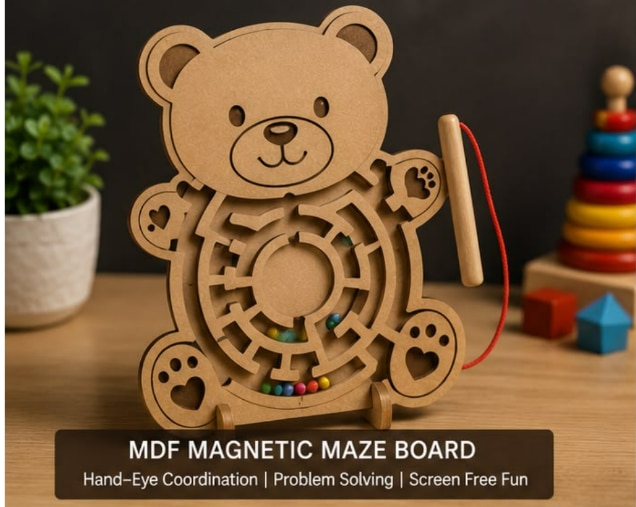 | MDF Toys For Kids MDF Magnetic Maze Board for Kids Laser Job Services is a manufacturer of creative and precision-cut MDF products, offering thoughtfully designed products for educational, activity... View product → |
Which custom maze applications make the learning goal clearer?
A route that ends at the correct answer teaches more than a route decorated with animals. Custom magnetic maze board applications work best when intersections, checkpoints and matching rules serve a defined task.
| Application | Path logic | Learning task |
|---|---|---|
| Colour-coded zones | Routes lead through named colours | Follow instructions and classify |
| Number sequence | Checkpoints show 1, 2, 3 and onward | Count and order |
| Transport route | Roads connect a station, depot or destination | Read maps and sequence movement |
| Community map | Paths link a school, clinic and market | Recognise places and directions |
| Habitat matching | Animals travel to the correct habitat | Match vocabulary and concepts |
| Product flow | A branded route follows production stages | Understand a process |
A visitor centre can show how an item moves from intake to display, while an activity centre can connect checkpoints to vocabulary or story prompts. Logos and characters alone create attractive artwork, not necessarily meaningful play.
For mdf magnetic maze board uses for kids in noida, define these before ordering:
- Age group and intended route difficulty
- Tabletop, wall-mounted or portable format
- Number of children sharing it and wiping frequency
- Language and curriculum terms to print
- Token size, route width and magnet-control requirements
Request one prototype before ordering multiple boards. Teachers can test visibility, movement, durability and task clarity, then adjust the design for their classroom routine. This is the practical value of customisation: one captive-magnet format can support different abilities, subjects and teaching goals.
Frequently asked questions
What does a magnetic maze help a child practise?
It practises hand-eye coordination, visual tracking, fine-motor control, planning, direction following, and correcting mistakes.
How should maze difficulty change with age and ability?
Start with short, wide routes and few turns. Add narrower paths, intersections, obstacles, and sequencing tasks as control and attention improve.
How can a play school turn the board into a learning activity?
Ask children to follow colour routes, count turns, name directions, match pictures, tell a story, or complete a timed route without prioritising speed.
What safety and construction checks should you make before purchase?
Check that the magnet and token remain captive, the board has no sharp edges or splinters, the surface is sealed, and the construction suits the intended age.
Which custom maze applications make the learning goal clearer?
Use alphabet, number, shape, colour, traffic, animal, map, or story-themed routes so the maze practises a named classroom skill.
Keywords