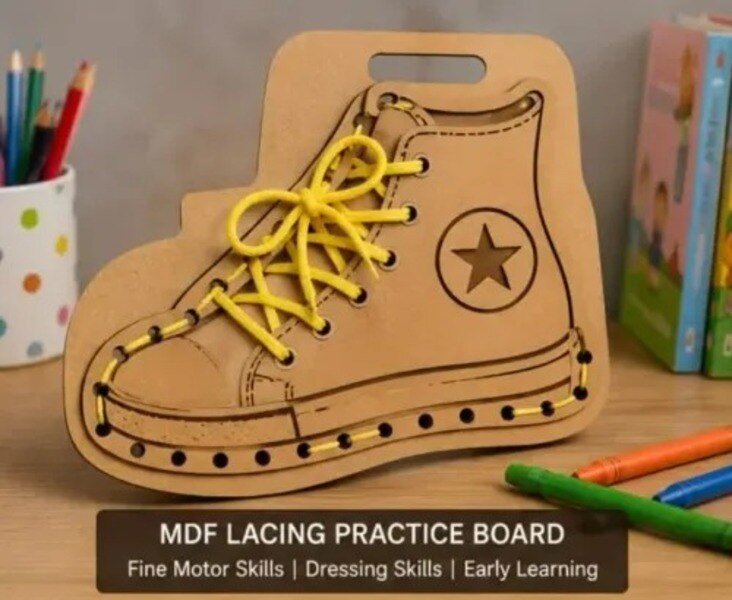
A child must do more than push a cord through a hole: they must hold the board steady, find the next opening, control the lace tip and pull with measured force. By the end, you will know which fine motor abilities lacing develops, how to scale the activity by age, and what to inspect before using or ordering a board.
Key takeaways
- Use lacing to practise pincer grasp, bilateral coordination and visual planning.
- Increase difficulty with hole spacing, lace stiffness and pattern complexity.
- Choose sealed, smooth MDF with rounded edges and secure lace ends.
- Specify board size, hole layout and finish for your setting.
What a child practises with every lace movement
Each lace movement combines precision with planning. On a laser cut lacing board for children, one hand stabilises or rotates the board while the other isolates the thumb and fingers for a pincer grasp.
- Locate the next hole by visual tracking, then plan the route and orient the lace tip toward its opening.
- Push the tip through while hand-eye coordination and visual-motor integration keep the movement aligned.
- Reach underneath or around the board to retrieve the tip, using wrist rotation as the direction changes.
- Pull the lace until the segment is firm, applying graded force rather than yanking it tight.
- Release the lace in a controlled way, reposition the fingers and prepare for the next movement.
- Repeat the sequence, controlling the order of holes instead of moving randomly.
This is bilateral coordination: both hands work together, but each has a different job. Repeated corners and changes of direction make lacing more demanding than tracing a line or inserting a peg because the child must update the motor plan after every segment.
Keep visual prompts simple. Numbered holes practise sequencing, route symbols support following a pattern, and colour cues add matching; too many graphics can distract from the motor task. The core practice remains the push, retrieve, pull and controlled release.
How lacing fits alongside other fine motor activities
Lacing combines four demands in one route: one hand stabilises or rotates the board, the eyes track the next hole, the other hand pushes and pulls the lace, and each movement follows an ordered sequence. That combination makes it different from activities that isolate one main action.
| Activity | Dominant demand |
|---|---|
| Lacing | Two-hand stabilisation, visual tracking, push-pull control and ordered routing |
| Threading beads | Repeated grasp-and-release with accurate alignment |
| Pegboards | Placing and removing pieces with hand-eye coordination |
| Button boards | Finger isolation, pulling and fastening through a slit |
| Tweezers | Pinch strength and controlled release |
| Play dough | Resistance, squeezing, rolling and shaping |
| Tracing boards | Controlled directional movement along a defined path |
| Busy boards | Switching between varied manipulation tasks and problem-solving |
Use these activities in rotation rather than treating lacing as a complete developmental programme. A short lacing route can follow bead threading, tweezer sorting or play-dough shaping, while a tracing board or pegboard changes the movement demand.
Lacing supports pre-writing-related control, including visual-motor coordination and graded hand movement, but it does not guarantee handwriting readiness. The child still needs stable posture, visual perception, letter knowledge and direct practice forming letters and words. A child who manages a lace route may still need separate support for pencil control, spacing or remembering letter shapes.
How to build difficulty without creating frustration
Start with three or four large holes in a straight line, using a thick cord that is easy to grip. Progress to longer routes, curves and corners; then add alternating colour patterns, over-under paths, timed challenges and child-created designs.
1. Match the board to the child’s control. Large holes, wide spacing, short patterns and thick cords suit preschoolers or children with weaker grip control. Introduce smaller holes, closer spacing, longer laces and more direction changes only after the child completes the route without repeated misses or excessive pulling.
2. Demonstrate the route once, then point to the next hole and ask, “Where does the lace go next?” Let the child orient, push, retrieve and pull the lace; avoid taking over when the route goes wrong. A brief pause supports problem-solving better than repeated adult correction.
3. Pause when the child abandons the task, grips the cord with both hands, rushes without looking or shows rising distress. Simplify by shortening the route, widening the holes or removing colour rules. Increase difficulty when the child finishes accurately, maintains manageable tension and asks for another challenge.
4. Use individual stations for focused practice, rotating trays for classroom variety, take-home kits for short repetitions and therapy-session tasks for targeted grip or sequencing goals. These formats suit MDF lacing board applications in Noida, including shared settings where each board can be checked and cleaned between users.
What makes an MDF lacing board safe to handle
1. Inspect the board before each use. Confirm that external corners are rounded, hole edges feel smooth, and enough MDF surrounds each hole to prevent breakout.
Reject it if you find splinters, loose fibres, cracks, obstructed holes, or laser soot that transfers to your fingers; wipe the cut edges clean and remove dust without thinning the material.
2. Test the cord, hole diameter, hole spacing and tip as one system. The stiffened tip must pass without excessive force, while the hole still provides useful resistance. A long loose cord can entangle; a detachable bead or separated tip can become a choking hazard, especially for children under three.
A permanently attached lace is easier to manage than several loose cords. Provide direct supervision for younger children, and reject any tip that can separate when pulled.
3. Ask the supplier for MDF emission classification or compliance documentation, a child-appropriate non-toxic finish and written cleaning instructions. Laser cutting alone does not prove that the board is non-toxic.
In shared use, inspect again after cleaning and after repeated pull-through cycles: check for raised fibres, opened holes, cracked bridges, loose tips, residue and markings that have become unreadable. Stop use immediately if any defect appears.
How to specify a board for home, school or therapy use
Home storage and shared-use durability require different specifications.
| Environment | Priority | Design choice |
|---|---|---|
| Home | Compact storage | Smaller finished dimensions, one attached lace and a wipeable coating |
| Preschool or school resource room | Cleaning and repeat use | Durable edges, retained lace, open-hole inspection and batch packaging |
| Occupational-therapy setting | Task control | Route variations, engraved prompts and dimensions matched to a defined motor goal |
| Event kit | Fast handling | Strong lace attachment, cleanable finish, protective individual packaging |
Give a custom MDF activity board manufacturer in Noida a written specification, not only an artwork file:
- MDF grade and thickness; finished length, width and weight
- Hole diameter, centre-to-centre pitch, corner radius and route design
- Lace length, tip construction and permanent or replaceable attachment method
- Edge treatment, child-appropriate coating and engraved prompts
- Quantity tolerance, inspection standard and packaging for storage or distribution
Trial hole diameter, pitch and lace tip together. A tip that will not pass creates frustration; an oversized hole removes useful resistance. For MDF lacing board uses for kids in Noida, specify whether the board serves an individual station, rotating tray, therapy task, take-home kit or promotional pack.
Accept every order functionally: every hole must be open, no edge or splinter should feel sharp, and the lace must complete repeated pull-through cycles without separating. Clean a sample repeatedly and confirm engraved markings remain legible.
Laser Job Services can be considered when you need a locally specified laser-cut MDF board or a batch built for a defined child-development task.
Related product
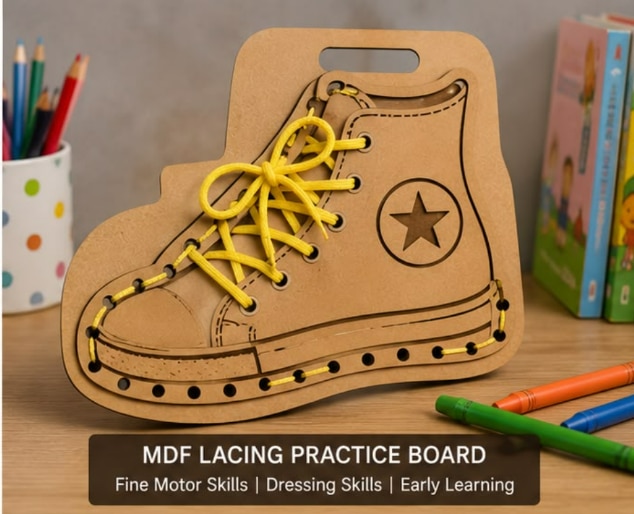 | MDF Toys For Kids MDF Lacing Practice Board for Kids Laser Job Services is a manufacturer of precision laser-cut MDF products, offering creative and educational activity products for children. View product → |
Frequently asked questions
What fine motor skills does an MDF lacing board practise?
Each lace movement practises pincer grasp, finger isolation, hand-eye coordination, bilateral coordination and planning. One hand holds or turns the board while the other threads the lace.
How can you increase lacing difficulty without frustrating a child?
Change one factor at a time: use larger holes first, then reduce hole size, increase spacing demands, use a less flexible lace or introduce a simple pattern. Return to the previous level when the child loses control or stops engaging.
What makes an MDF lacing board safe for children?
Look for smooth sanded surfaces, rounded edges, sealed MDF, cleanly cut holes without sharp residue and a lace with secure ends. Inspect the board before use and replace it if the MDF swells, cracks or splinters.
How should you specify an MDF lacing board for home, school or therapy use?
State the child’s age and skill level, board dimensions, hole diameter and spacing, lace length and stiffness, finish, edge treatment and intended activity. Schools and therapy settings also need durable construction and easy cleaning.
Keywords