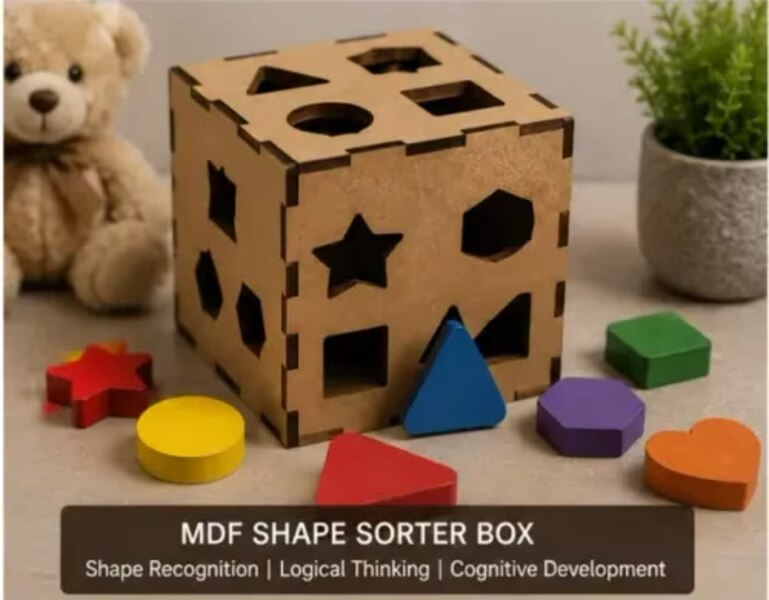
Children learn more from a shape sorter than from dropping pieces into a box: they select, rotate, compare, adjust and try again. By the end, you will know which skills the activity supports, how to adapt it for different ages and classroom routines, and what to check when choosing or commissioning a safe MDF version.
Key takeaways
- Match piece size and difficulty to the child’s developmental stage.
- Use naming, sorting and counting prompts to extend shape-sorter play.
- Specify smooth edges, secure joints, non-toxic finishes and age-appropriate pieces.
- Choose custom MDF designs that support classroom or therapy goals.
What a child actually learns while using a shape sorter
A child develops shape recognition, colour matching, visual discrimination, hand-eye coordination, pincer grip, spatial reasoning, problem-solving, persistence and language through a shape sorter.
The activity begins with selection: the child chooses a piece and compares its outline with an opening. If it does not fit, the child rotates it, changes hand position, adjusts force and tries again. After inserting the piece, retrieving it provides another repetition of the same movement and reinforces cause and effect.
A shape sorter box for play schools becomes more valuable when an adult changes the prompt instead of correcting every attempt.
| Task | Child’s action | Learning supported |
|---|---|---|
| Match shapes | Compare a piece with an opening | Shape recognition and visual discrimination |
| Match colours | Group or insert pieces by colour | Colour vocabulary and classification |
| Count pieces | Touch and count each piece | One-to-one correspondence and early number language |
| Explain a choice | Say why a piece fits or fails | Reasoning, vocabulary and sentence building |
| Give a clue | Follow “turn it” or “find the red circle” | Listening and problem-solving |
Start with free exploration, then name the shapes and colours. Later, ask, “What made you choose that hole?” This encourages the child to describe a decision rather than guess.
The box supports learning; it does not independently raise intelligence or prove that a child understands geometry. Progress depends on age, task difficulty, adult interaction and repeated opportunities to try, fail safely and try again.
How to match the box to a child’s stage of development
Start with fewer, larger and clearly different shapes; add pieces, reduce visual clues and introduce rotation only after the child succeeds without constant help.
1. For a beginner, use two or three large pieces with distinct profiles, such as a circle, square and triangle. Give each shape one uniquely matching opening, with contrasting colours and generous hand space. The child can focus on selecting, turning and inserting without being overwhelmed.
2. For a child who matches confidently, increase the set to four or six pieces. Keep them easy to grip, but introduce different orientations, less obvious colour cues and openings that require a quarter-turn before the piece fits. Add one repeated shape only when the child can discriminate between profiles.
3. For a more experienced child, use six to eight pieces with similar outlines, repeated shapes or openings that face different directions. Reduce colour contrast and make the matching task depend on outline, rotation and spatial reasoning rather than colour alone. Keep every piece large enough for controlled handling.
Advance after several successful attempts with little prompting, not after a fixed birthday. If the child forces pieces, abandons the task or needs repeated correction, remove one difficulty—such as repeated shapes or rotation—before trying again. Progress should stretch problem-solving without turning practice into frustration.
Activities that turn free play into guided learning
Ask the child to do more than find a matching hole: name, compare, sort, count and explain each choice. Change the prompt as the child gains confidence, so the same box supports open exploration, guided practice and useful observation.
- “Find all the red pieces,” then sort them by colour before touching the openings.
- Ask, “What shape is this?” and invite the child to describe its sides, corners or curves.
- Give a verbal clue such as, “Find the piece with three corners,” without pointing to the answer.
- Count the pieces together, match one piece to one opening, and check whether any are left over.
- Ask the child to predict whether a piece will fit, rotate it when needed, and explain what changed.
- Offer two similar pieces and ask, “Which one belongs here? Why does the other one not fit?”
- Take turns choosing a piece, naming it and passing the box to another child.
- Pause after an unsuccessful attempt and ask, “What could you try next?” rather than correcting immediately.
In a preschool group, a teacher can use these prompts to compare how children approach the same challenge: who checks the outline, who rotates the piece, and who seeks help. Useful custom MDF shape sorter applications include colour-and-shape matching, vocabulary practice and turn-taking stations. Keep the tone playful; repeated correction can replace curiosity with guessing.
Using shape sorters in play-school and therapy routines
A shape sorter supports small-group teaching, independent work, observation and classroom organisation when each use has a clear routine. In a group of three or four, give each child one piece, name its colour or shape, and ask for a turn before passing the box.
Children practise waiting, listening and explaining choices without competing for every piece.
- Small-group teaching: change the prompt from “Find the hole” to “Find a red triangle” or “Show why it does not fit.”
- Independent work: place a box on a labelled shelf with a picture guide, then let the child attempt the task without immediate correction.
- Observation: record whether the child scans the openings, rotates the piece, persists after failure, or abandons the task.
- Classroom organisation: count the pieces before storage and keep each set in a marked tray or bag so missing parts are noticed quickly.
In therapy sessions, use the same box for short, repeatable activities: matching, requesting, turn-taking or following a one-step instruction. Start with free exploration, then add language and problem-solving prompts; do not turn every failed attempt into a correction.
Questions about mdf shape sorter box uses for kids in noida should include the age group, number of children sharing each set, replacement-piece availability and whether the surface can be wiped between users. A production sample also reveals whether the pieces are easy to grip and the openings remain visually clear.
What to specify when buying or customising an MDF shape sorter
Specify the age band, piece count, opening size, material grade, finish and test method before approving a custom MDF shape sorter. A colourful design can still fail if a piece jams, splinters or fits through an opening that is too small for safe retrieval.
| Option | What it means | When it applies |
|---|---|---|
| 3 mm MDF | Lightweight panels with lower impact resistance | Use for prototypes or supervised home play |
| 6 mm MDF | Stiffer walls and better resistance to pulling | Suitable for regular classroom handling |
| 9 mm MDF | Heavier, stronger construction with larger edges | Use for high-use centres or therapy rooms |
| Raw MDF | Unsealed composite wood with exposed fibres | Avoid for products needing wipe-clean surfaces |
Ask the MDF learning toys manufacturer to provide:
- The MDF grade, thickness tolerance and formaldehyde-emission information for indoor use.
- Water-based, child-safe coating details, adhesive type and cleaning instructions; test that the coating does not peel after repeated wiping.
- Rounded external edges, soot and loose-fibre removal after laser cutting, and a lid that cannot pinch fingers.
- Oversized or captive pieces where choking risk is possible, plus a replacement-piece plan.
- A production sample for checking piece-to-opening matching, orientation, piece count, edge quality and resistance to pulling and twisting.
For laser-cut educational toys in Noida, confirm whether the finished toy requires BIS certification under the applicable IS 9873 toy-safety requirements. Ask Laser Job Services to document the finished toy’s materials, coatings, detachable parts and packaging rather than relying on the laser file alone.
Related product
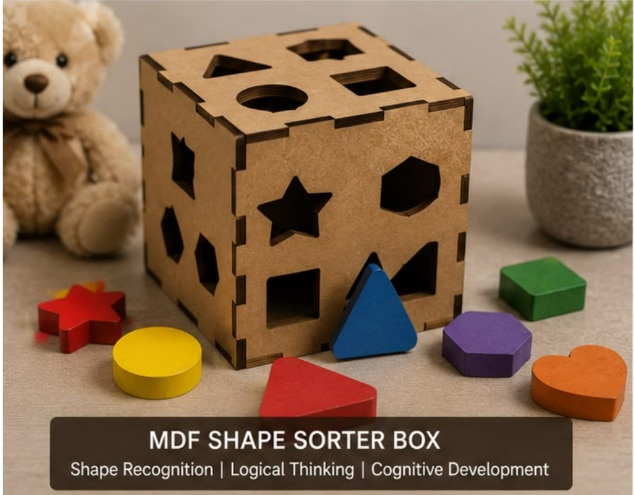 | MDF Toys For Kids Laser Job Services is a manufacturer of precision laser-cut MDF products, offering creative and educational activity products for children. View product → |
Frequently asked questions
What does a child learn while using a shape sorter?
Shape sorters develop shape recognition, colour matching, visual discrimination, hand-eye coordination, pincer grip, spatial reasoning, problem-solving, persistence and language. Adults can extend learning by asking the child to name, compare and describe each piece.
How do you match a shape sorter to a child’s developmental stage?
Start with larger pieces, fewer openings and strong colour contrast for beginners. Add more shapes, closer visual matches and tighter spatial challenges as the child improves. Check that each piece is large enough to reduce choking risk and easy to grasp.
How can you turn shape-sorter free play into a guided activity?
Ask the child to identify a shape, find its matching opening, describe its colour or count the pieces. You can also sort pieces by colour, compare sizes, hide one piece for recall practice or give verbal position cues such as above, below and beside.
What should you specify when buying or customising an MDF shape sorter?
Specify the child’s age range, piece dimensions, number and type of openings, colour scheme, edge finishing, joint strength, surface coating, cleaning needs and intended use. For play schools or therapy settings, also define durability, replacement pieces and the learning objective.
Keywords