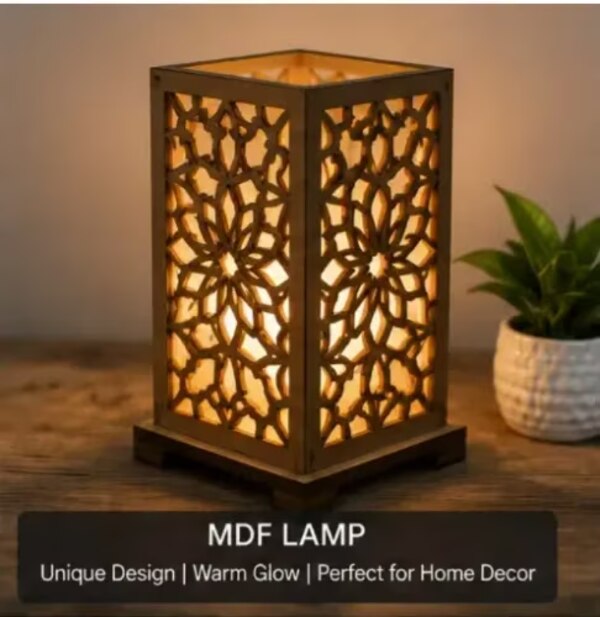
Choose the lamp by its room, lighting job, available footprint and tolerance for maintenance—not by the cut pattern alone. You will be able to match an MDF form and pattern to your décor, specify a workable size, select a safer bulb system and reject designs that are unsuitable for the room.
Key takeaways
- Match open panels and pale finishes to minimalist or Scandinavian rooms.
- Use dense cut-outs for richer shadows and open patterns for brighter light.
- Keep bedroom lamps stable, ventilated and free from exposed hot bulbs.
- Specify height, width, depth and cable access before ordering custom sizes.
Match the lamp form to your décor scheme and room
Minimalist and Scandinavian rooms suit compact table lamps with simple open panels, pale finishes, light colours and low pattern density. Bohemian spaces benefit from irregular botanical or mandala cut-outs, warm stains and richer shadows; traditional rooms suit symmetrical floral, architectural or jaali forms.
Industrial rooms pair dark-stained MDF, exposed edges and metal accents with sparse patterns. Children’s rooms need rounded, enclosed, low-glare forms with securely concealed cables.
| Room | Footprint | Mood | Lighting function | Pattern density | Finish | Maintenance burden | Production effort | Recommended style |
|---|---|---|---|---|---|---|---|---|
| Minimalist | Compact | Calm | Ambient | Low | Pale, matte | Low | Low | Open-panel table lamp |
| Scandinavian | Compact | Airy | Ambient | Low | White or birch-toned | Low | Low | Pale geometric lamp |
| Bohemian | Medium | Layered | Accent | Medium-high | Warm stained | Medium | Medium | Botanical or mandala lamp |
| Traditional | Medium | Formal | Ambient/accent | Medium | Painted or walnut-toned | Medium | High | Symmetrical jaali lamp |
| Industrial | Medium | Graphic | Accent | Low-medium | Dark stain, exposed edge | Low | Medium | Metal-accented pendant |
| Children’s room | Small | Gentle | Night-light | Low | Sealed, rounded | Low | Medium | Enclosed low-glare lamp |
A table lamp needs a stable base and controlled cable route; a pendant needs ceiling fixing and suspension strain relief; a wall lamp needs a secure bracket and rear clearance. A night-light or backlit panel needs shallow depth and glare control.
MDF lamp options for home interiors provide illumination, unlike an MDF wall clock, wall art, key holder or coaster, which provide timekeeping, storage or surface decoration.
Choose the cut pattern according to the light you want
Choose the cut pattern by deciding whether the lamp must glow broadly, cast dramatic shadows or create a visual focal point. Good laser-cut MDF lamp design choices also protect narrow bridges and prevent fragile isolated pieces.
| Pattern | Effect | Best fit |
|---|---|---|
| Geometric jali | Orderly shadows and controlled brightness | Modern rooms |
| Floral | Softer, organic shadows | Traditional or bohemian rooms |
| Mandala | Strong central focal point | Large bedrooms or feature tables; it can overwhelm a small bedroom |
| Lattice | Repeatable, even shadow bands | Consistent decorative lighting |
| Architectural cut-outs | Structured, graphic illumination | Offices and industrial interiors |
| Personalised names or motifs | Memorable detail | Designs readable at the lamp’s actual viewing distance |
Dense patterns create detailed shadows and block more direct light, while narrow bridges can weaken during cutting or handling. Sparse, large openings increase light output, reduce glare and improve structural strength; larger pattern scale also creates larger shadows. Bulb position, viewing distance and diffuser placement change hot spots and shadow sharpness.
Use a broad, open shade for ambient lighting and a dense dramatic pattern for accent lighting. For reading or desk work, use a separate certified task lamp: a decorative MDF shade rarely distributes enough light for close work.
Before approval, require a full-scale paper mock-up, digital room render or physical sample cut from the specified MDF thickness, with the intended bulb and diffuser installed.
Make a decorative MDF lamp for a bedroom safer and more comfortable
Check the complete lamp before placing it beside a bed: use a low-heat LED system, then verify the socket, holder, wiring, shade clearance and intended wattage together. Wattage alone does not establish safety; enclosure shape, ventilation, fitting temperature and wiring quality also matter.
| Colour temperature | Bedroom effect | Best use |
|---|---|---|
| 2700K warm white | Restful, softer ambient light | Bedside relaxation |
| 4000K neutral white | Clearer, more alert visibility | Dressing or occasional reading |
Ask for:
- The maximum bulb wattage and socket certification
- Ventilation openings and flame-retardant treatment
- Smooth edge finish and cable strain relief
- Earthing where applicable
- Confirmation that the exact LED, enclosure and fitting were tested together
Keep the decorative MDF lamp for bedroom use away from bedding, curtains, water, unstable table edges and cable-snag routes. A low-heat LED still needs clearance, and a decorative night light is not automatically a certified electrical fixture.
Ask a qualified electrician to check mains wiring, or any uncertainty about the plug, switch, adapter, socket or earthing arrangement. Stop using the lamp if the MDF darkens, smells, warps or becomes unusually hot.
Specify proportions and custom MDF lamp sizes in Noida
A lamp should occupy less than the usable surface beneath it: keep the shade within the furniture’s edges, then check that the bulb or LED module fits without touching MDF.
| Placement | Proportion and clearance |
|---|---|
| Bedside table | Use a footprint no wider than one-third of the usable table width; keep drawers, switches and the cable exit clear. |
| Console | Keep the base within its top depth and below the sightline of nearby décor; check centre of gravity against knocks. |
| Shelf | Measure shelf depth and load rating; prevent the shade or cable from projecting into the walking path. |
| Desk | Keep the footprint away from writing space, drawers and monitor glare; use a separate certified task lamp for close work. |
| Floor-standing | Make the base broad enough for the height and mass; route the cable along the rear, never across a walkway. |
For custom MDF lamp sizes in Noida, provide overall width, depth and height, MDF thickness, bulb or LED-module envelope, socket access, cable-exit position, assembly direction and flat-pack requirements. Attach a drawing showing cut-out width, base footprint, centre of gravity, slot and tab dimensions, replacement-part access and every electrical fitting.
Ask Laser Job Services whether it provides a design proof, supplies or fits hardware, packages the lamp for transport, supports repairs or replacement parts, and meets your delivery deadline. Confirm each service; do not assume a local maker includes it.
This specification also helps compare MDF lamp styles for home decor in Noida without choosing a shape that blocks furniture or safe bulb access.
Related products
 | Decorative MDF Coasters Laser Job Services is a manufacturer of precision laser-cut MDF products, creating decorative and functional products for homes, offices, gifting and... View product → |
 | Decorative MDF Coasters Laser Job Services is a manufacturer of precision laser-cut MDF products, offering creative and decorative solutions for home interiors, offices,... View product → |
Compare MDF with other shade materials before committing
MDF is the better choice when you want crisp, opaque shadows, fine pierced detail and a warm board surface at a controlled indoor cost. Choose another material when moisture, impact, heat or easy washing matters more than pattern precision.
| Material | Light and shadow | Heat, appearance and durability | Cleaning |
|---|---|---|---|
| MDF | Blocks light for sharp, high-contrast shadows | Warm surface; lower heat and moisture tolerance; absorbent edges | Dry or barely damp cloth |
| Acrylic | Transmits more light with softer shadows | Bright, clean look; scratches and can soften under unsuitable heat | Wipes clean easily |
| Fabric | Diffuses light softly | Comfortable appearance; collects dust and offers limited impact resistance | Vacuum or dust gently |
| Plywood | Moderate transmission with visible layered edges | Stronger dimensional character and a natural look | Dry or lightly damp cloth |
| Solid wood | Opaque, defined shadows | Heavier natural finish; fine pierced detail is more limited | Dust carefully; repair finish locally |
| Metal | Strong directional light and hard shadows | Highest heat and impact tolerance; cooler visual character and more glare | Wipe clean; check for corrosion |
Paint, laminate, veneer and sealant change stain resistance, edge appearance and repair options. Seal MDF edges properly; paint alone does not make standard MDF waterproof. Keep unfinished MDF away from bathrooms, kitchens, condensation, spills and damp walls.
Reject MDF for outdoor balconies, wash-down areas, persistently humid rooms, high-impact public spaces, high-temperature bulbs or undocumented fire-performance requirements. Consider sealed plywood, metal, glass, acrylic or a certified fabric shade instead. Check fasteners, joints and cables during cleaning.
Control customisation effort, proof approval and final installation
A reference image becomes vector artwork before cutting; the artwork must be checked for minimum bridge widths, nested efficiently, fitted with tabs or slots, then panels sanded, sealed, painted or laminated, assembled around hardware and packaged. Each revision adds decisions and production stages, so approve a complete brief before ordering.
1. State the room, use, overall dimensions, pattern reference, MDF thickness, finish, bulb and fitting, cable colour, switch location, quantity, installation method and deadline. Ask for a full-size proof cut from the actual board, not a screen image.
2. Approve face colour, laser-edge darkness, soot transfer after cleaning, sharp edges, glare, shadow contrast, cable route and cleaning access. Require a kerf test coupon: slot widths must match the actual board and machine setup. Reject isolated islands, fragile bridges and sharp internal corners.
3. At delivery, check dimensions, warped panels, burnt or chipped edges, loose joints, missing hardware, wrong finish, unstable geometry and damaged wiring. Final sign-off requires ventilation, access to replace the bulb or fitting, and inspection of the complete electrical assembly against applicable local BIS/IEC requirements.
An attractive pattern fails if you cannot assemble, clean, repair or safely install it.
Frequently asked questions
Which MDF lamp style suits a minimalist or Scandinavian room?
Choose a compact table lamp with simple open panels, pale finishes, light colours and low pattern density.
How does an MDF lamp cut pattern change the light?
Open, low-density patterns produce brighter, broader light, while dense cut-outs create stronger shadows and a more intimate glow.
How can you make a decorative MDF lamp safer for a bedroom?
Use a stable base, provide ventilation, keep the shade clear of the bulb and select a cool-running LED lamp.
What measurements should you provide for custom MDF lamp sizes in Noida?
Specify the finished height, width, depth, base dimensions, bulb clearance, cable-exit position and available table or floor space.
How does MDF compare with other lamp shade materials?
MDF offers precise opaque patterns and a solid appearance, while fabric gives softer diffusion and metal provides thinner, more open structures.
Keywords